Out of the blue, my childhood friend and former neighbor Rita texted me a while ago to tell me that she had gone back to Lebanon, where we both grew up, for the first time in forty-three years. A few seconds later, she sent me several photos. One showed the building we both lived in in the Beirut neighborhood of Achrafieh, which my family moved out of in 1986 when we immigrated to the U.S. Another showed a set of stairs, with dank and dirty walls and steps. “Our shelter,” Rita, who has lived in Canada since 1980, wrote. It was an innocuous image, but it was loaded with emotions. I could smell the musty, metallic air of those stairs, which led to the basement. At the bottom, to the left, was our past and our life of fear, dread, and threat.
Rita and I were both five when the Civil War in Lebanon started in 1975. We spent many nights and days huddled together with the rest of our neighbors in the basement of our building, which we had turned into a shelter, as a barrage of missiles rained down on our area in what was then known as East Beirut. One day, three years into the war, eight-year-old Rita was slightly injured. It was the most terrifying incident from the eleven years of war I lived through in Lebanon and the closest to death I’ve ever felt.
While that period was long ago and far away, shelters recently became an unavoidable daily horror for residents of Iran, Lebanon, and other countries. The United Arab Emirates was transformed overnight from a bastion of safety to one of threat. Civilians all over the region were forced to hunker in basements and garages to shield themselves from the missiles and violence that suddenly took over their daily lives. As these images have proliferated, I have repeatedly found myself almost physically transported back to that space and to the childish, chest-crushing fright that I’d carried with me all those years and only had the chance to discuss with Rita when she texted me about her seminal visit back to Lebanon.
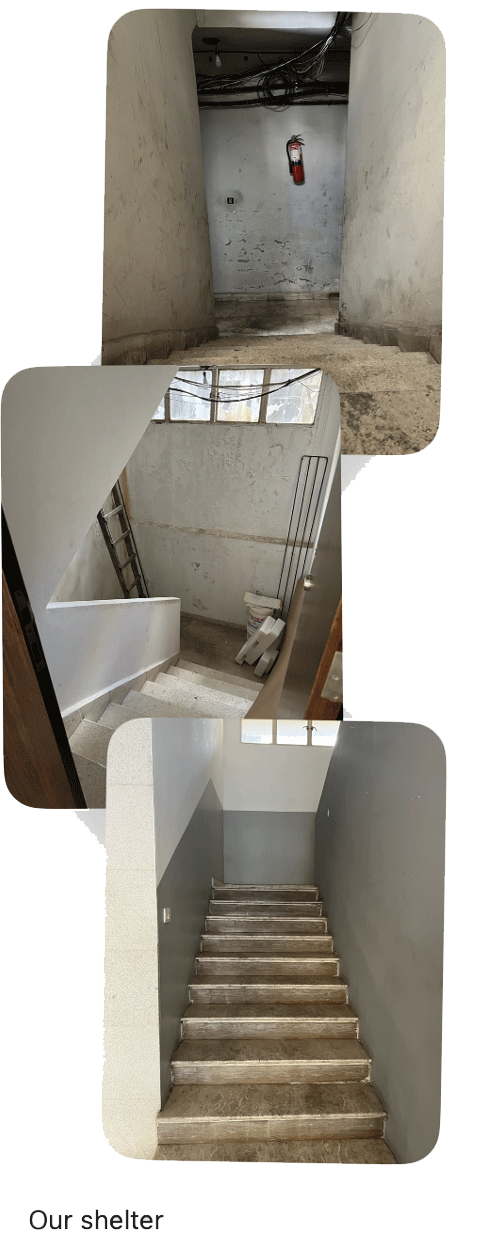
The fighting that broke out the day Rita was injured interrupted several months of relative calm. Throughout the previous three years, we’d heard many stories of people surviving because of a near split-second decision—getting up from their living room chair to go to the bathroom and a mere seconds later a bomb striking the exact spot they just vacated. This was that kind of day for us: a series of instant decisions had saved our lives. I had gotten many of the details at one point in my mid-twenties from my mother and father. They were both Palestinian-born but met and married in Beirut after their families moved there separately; the U.S. was their third home.
The morning had started with my father, Tony, going to his office, and my three siblings and I going to our respective schools. By midday, we were all scurrying home as the bombs grew louder and closer. My father’s two-mile drive home from his office in the Sin El Fil neighborhood had been very dicey. He described it to me in the early 1990s, explaining how he had to dodge burning cars and exploding shells and how anxious he was about our safety.
When he finally arrived at our building, he parked his car and sprinted down the stairs to the building’s basement, where he hoped to find us. We were all there. My mother had picked up my older sister Ghada (third in line) and me (the youngest) from our school, and we had arrived seconds before him. One of our neighbors, whose children attended the same school as my brothers Ghassan and Jabbour (second eldest and eldest), had brought them back with him. My father walked straight over to our neighbor, firmly shook his hand, and thanked him.
“Don’t mention it,” the neighbor said. “We’re all here for each other.”
And the truth is, we were. The war had forced us into a closeness and a sense of communal spirit that goes beyond what neighbors in a time of peace experience. And here we all were again, including the family who came down to the shelter only at the worst of times, huddled in the basement.
We spent the rest of that day in the dark, damp, concrete-sanctuary, cowering, deafened by the pounding of heavy artillery all around us.
I was terrified by the bombardments, yet I had grown to like going down to the shelter—looked forward to it, even, my friends and I in our pajamas playing Risk and card games, enjoying our endless slumber party, my mattress laid out next to Rita’s mattress, my breath intermingling with all the others until they formed one. Safety in numbers—maybe that’s why I felt more at ease in the basement, finding someone to share my anguish and to divert my attention from it. With my friends, my neighbors, my sister, my brothers, and my parents within my sights, I could close my eyes and rest, appeased by the notion that, down here, enveloped by reinforced concrete on all sides, we were all out of harm’s way.
Then, suddenly, in one explosive instance, even the safety of that haven was shattered. Looking back at it now, I can’t help but ponder the extraordinary few moments leading to the event, as if we all were anticipating its arrival, subconsciously preparing for it.
On the second day, after a full night of continuous shelling spent in the basement, the warring parties finally decided to take a rest. Encouraged by a prolonged bout of silence, my father and a few other men began packing up their folding chairs and table and announced that they were moving to the top of the stairs, on the ground floor, to play cards, exposing themselves in open space.
Their wives were furious.
“The war isn’t over yet, you know,” one of them yelled out to her husband.
“You men are being idiotic,” another wife scorned in frustration.
“Ya Michel, this is really irresponsible of you. Why can’t you play down here where it’s safe and where we can see you?” Miraise, Rita’s mother, pleaded with her husband (“ya” is a colloquial Arabic word used when addressing someone). The men consulted each other.
“Ok, fine, then we’ll play right outside, at the bottom of the stairs,” Tony said.
Miraise urged my mother to intervene and try to convince the husbands to reconsider their plans.
“Ya Tony, the bottom of the stairs is exactly like the top of the stairs. Look at all these windows above you, you’re surrounded by glass,” my mother said, and the other wives nodded their heads in agreement. We all knew that if a bomb hit close enough, it would cause the implosion of glass with shards shooting into the air.
“We’ll be fine out here. Don’t worry,” one of the husbands replied.
Convinced that all of their begging was in vain, the women returned inside the shelter. I was huddled with a group of kids, including Rita, in one corner. Ghada had just awakened from a nap and was sitting on a nearby mattress. The mattresses were strewn all along the walls and we slept head-to-toe next to one another, in our day clothes or PJs, if we’d had time to grab any. Ghassan and Jabbour were goofing around with a few of their friends in the adjacent room.
Two, maybe three minutes later, my mother had an epiphany.
“You know what, Miraise?” she said as she stood in front of the group of women seated in a row directly beneath one of the small windows in the shelter. “See that window? You’re all in its line of fire. If a bomb explodes near it, any flying glass or shrapnel will travel straight towards where you are.”
Miraise vaulted out of her seat and the other women followed.
Not a heartbeat after that, an ear-splitting blast reverberated throughout the shelter, causing the ground beneath our feet to shake, as if in an earthquake tremor. A cloud of black smoke seethed through the window and engulfed the entire space in pitch darkness. Shrapnel, pieces of glass and debris torpedoed our way.
A stone-dead silence filled the air as we all waited for someone, anyone, to move, react, make a sound.
And then, suddenly, simultaneously, the mad, screeching shouting erupted. Mothers were hysterically calling out the names of their children; the shelter was divided into two parts by a concrete cinder block wall, and the kids were seated in the hall right under the window from where the explosion was heard. The children, who had dashed out of their playing area into the center of the shelter, were crying out their parents’ names. I could hear my mother’s voice in the background—she was calm and trying to spread that calm to the women around her. I wanted to call out for her, but the heavy dust seeping through the small window was making my eyes tear and my throat itch. I couldn’t get the words “Mommy, Mommy,” I was repeating in my shell-shocked brain to come out of my numb mouth. I had no idea where my sister or my brothers were. I was listening intently to the screaming to distinguish one of their voices—even though they were fearless and therefore unlikely to shout—but Rita was yelling that she was hurt, my best friend needed me but I couldn’t reach her, so I grabbed someone’s hand and held it tightly—it was cold yet comforting, and it appeased my anxiety—and we walked around lost amidst the dark and the dust and the turmoil, shoving our way toward the echoes of the mothers’ frantic cries.
Time stood still while everyone waited to hear the voices of the men. “We’re O.K.,” finally one of them said. As it turned out, they had given in to the wives’ pleading and had remained inside the shelter’s parameters.
One husband frantically called out to his wife, hoping to find her. But with all the commotion, it was a hopeless search.
“EVERYONE QUIET! SILLLEEEEENNNNCE!” my father yelled out, and I was relieved to hear his commanding voice. The place went quiet. Not a word. Not a breath. Not a movement. Following another elongated, perplexed silence, the shouting, the crying, the coughing, the hysteria started again.
“QUIET! QUIET! LET’S SEE WHAT HAPPENED!” my father demanded as he switched on the flashlight which he had finally located. Everyone hushed. The other men scurried toward the flashlight and began amassing candles. Once the candles were lit, I could see that I was holding my youngest neighbor’s hand. She had remained silent throughout. A look of white terror filled her soft, pale face. I squeezed my palm into hers and led her to her mother. She collapsed in her mother’s arms.
Others were still running towards each other.
“Are you all right? Are you hurt?” the mothers asked.
“What was that? Did it land in the building?” the children asked.
As we all gathered, we realized that some of the children had been hit by shrapnel.
Thankfully, one of our neighbors was a doctor. She instructed the hurt ones to form a line, and she triaged them, tending to the wounded in order of urgency. The mothers stood next to their children, comforting them, holding their hands, and stroking their hair. Rita was first in line. I watched the doctor operate. She carefully extracted a piece of black shrapnel from Rita’s thigh with what appeared to be a giant pair of tweezers. The area next to the wound was red and inflamed, but luckily, it was a minor injury, as were all the others.
The radio announced that a ceasefire was now in effect. We waited a couple of hours, a sensible amount of time to make sure the edict would be observed by the trigger-happy warring factions, then my father and a few other men decided to scope out the building in search of damage and fire. They didn’t have to go far. The shell had landed in the apartment located on the ground level. As my father would later tell me, most of the apartment’s furniture was burnt and shredded; the walls of the master bedroom were demolished; the bathroom, the living room, and the kitchen were reduced to a big gaping hole. A cloud of white dust enveloped the entire apartment.
The men proceeded to the open parking lot in the back of the building, directly next to where the bomb had landed. The ground was covered with crunching glass from the cars and from the doors and windows throughout the building that had come crashing down. The shell had destroyed several cars; two of them, including the one belonging to Rita’s family, were unsalvageable. Tony asked the owners of a couple of other cars if he could remove the batteries to help light the basement. They quickly agreed. My father, a trained engineer, extracted the batteries and any light bulbs that were accessible, then he brought down wires from our apartment with which he created plugs and light bulbs and switches.
The radio declared that the ceasefire was only temporary. It urged civilians to remain in protected surroundings until further notice. There was only one thing we could do: plug in the portable radio into the car batteries, put on some disco music and dance. My father was the first to step onto the dance floor. His partner was a five-foot-nine young woman from the northern town of Zahle who was visiting family in our building and was now trapped with us in Achrafieh. Unable to reach her shoulders, my five-foot-seven father asked my mother to lend him her high heels. We laughed and laughed and laughed—ignoring and defying our predicament. By then, denial had become our most reliable and soothing weapon of survival.
Lebanon’s Civil War was complex and multipronged and too dizzying for anyone to follow – though the adults did their best to try.
In between meals in the shelter, the adults broke out into heated political debates, each one passionately extrapolating on his or her own conspiracy theory, claiming irrefutable understanding of the latest developments, of who was now fighting who and why and what this will surely lead to—as if any mere citizen could ever get a handle on the ever-changing and chaotic political situation that we found ourselves in. Meanwhile, the other children and I played cards and game boards, pausing intermittently to guess how close or how far the next bomb would fall—after a mere three years, we could already approximate the final destination of a missile, and whether it would hit close, by the intensity of its accompanying whistling sound. The mothers, insisting on providing their families with adequate and healthy nourishment—lack of kitchen countertop or utensils be damned—would be busy preparing breakfast, lunch, and dinner in the restrooms using camping gas heaters.
The war involved numerous militias and several countries—Syria, Israel and, at one point, the U.S., which suffered catastrophically—and each assailant’s allegiances shifted repeatedly. As my father would go on to say on one of the tapes he recorded for me after we moved to the U.S., “the war in Lebanon was full of twisted truths.” Average Lebanese were left helpless in the face of the constant threat; they didn’t factor in the self-interest of each enemy who was adamant in achieving its objectives at whatever cost. “Was there any truth to which the Lebanese layman could put hopes on for a resolution to this dilemma?” my father asks on the tape. He then pungently answers his own question: “No way, no way, no way anybody, even with the most logical mind or the most stupid mind could make out any truth of all that was said or all that was happening around that Lebanese poor self.”
Like many citizens caught up in the crossfire – literally – between two tenacious camps, the only choice was to hunker down, hope for the best and then, when a ceasefire allows for some normalcy to resume, just get on with your life, as best as you can, pretending that it’s all fine, or, if it isn’t now, it soon will be.
The day after Rita’s injury, another ceasefire was announced, but we feared that this one wouldn’t last long either. My father decided that we would relocate to my grandmother’s home in Unesco, on the West Side of the divided city, until the situation in Achrafieh quieted down. It was often the case that the fighting would be confined to one side while the other enjoyed serenity, momentarily at least. There was but a small window of time to evacuate from our neighborhood. My father piled us into our car, windshield shattered, and wore ski goggles to shield his eyes from any loosened bits of glass.
Rita and her family followed in our green Vauxhall—they also wanted to flee to West Beirut, but their car was charred to nothingness. My father offered them the car that Camelia, my mother’s younger sister, had left behind when she moved to Dubai a couple of years earlier. All of its windows were in place.
Rita’s family traveled abroad to escape the ongoing hostilities and never came back. I was heartbroken by her departure. Having her nearby had been both fun and comforting. It made living through the war a bit more bearable. While my siblings, or my parents, didn’t seem to mind life in Beirut at the time, I hated living in a war, and in the years that followed, I sank into a semi-depression. I desperately wanted to leave. We finally did in year eleven of the fifteen-year Civil War. I was sixteen.
These events and those of the day the bomb hit the ground floor are among the moments I most vividly remember. We were lucky that day in the shelter. Many others were not. Hundreds died. But even the less tragic moments of war are insidious and corrosive.
The long-lasting psychological effects on civilians who live through war have not been studied thoroughly or systematically. The research that has been done isn’t all that surprising. A review paper conducted in 2005, a year that marked the 30th anniversary of the end of the Vietnam War and of the start of the war in Lebanon, noted: “Among the consequences of war, the impact on the mental health of the civilian population is one of the most significant. Studies of the general population show a definite increase in the incidence and prevalence of mental disorders.” The paper concluded that women and children are the most affected.
Other studies have shown effects on fertility and trauma-related problems in children.
A World Health Organization report on mental health in post-conflict countries, released in 2004, noted that many people around the world at the time were living through conflict. Since then, several new wars have erupted, including ones in Syria, Libya, Yemen, Ukraine, Gaza, and, more recently, several cities in the Middle East. Scores of civilians have died in these wars. Scores more have suffered or will suffer from prolonged grief, the loss of their homes, the loss of their childhoods, and witnessing staggering brutality.
As long as there have been wars, people have sheltered underground. But it wasn’t until airplanes with bomb-dropping mechanisms were debuted at the turn of the last century that the threat came from the sky. The U.K. built several communal shelters in the 1940s, but during the Blitz in London in World War II, people instinctively rushed to underground structures, most notably the Underground stations, which the British administration wisely outfitted with bunk beds, first aid facilities, and chemical toilets. It even appointed marshals to keep the order. One photo I found shows a couple dancing in the Underground, just like my father and his tall partner did that night in our shelter in Beirut.
While the U.S. had suffered attacks on its territories during that war, it was only in its aftermath, in response to the threat of nuclear war, that it sought to build communal shelters for Americans. In 1961, Congress voted to spend more than $160 million on these structures, which were marked with a clear sign featuring three yellow inverted triangles on a black and yellow background. By the late 1970s, the fallout shelter program was discontinued. The shelters were largely decommissioned and most of the signs denoting their locations were removed, though, recently, I came upon one in Long Island City, NY. It was jarring to encounter it on a quiet, leafy street. I wasn’t sure if it was still operable. I was half-relieved to know that it could be an option should disaster strike and half-horrified by the idea that I and my...