A persistent regime of low wages may determine very negative long-term consequences on the economy.
Reading
Stagnating real wages may have contributed to the slowdown of US productivity
In much of the advanced world, we have witnessed at least three decades of stagnating real wages and massive reductions in the labor share in income. Many analyses have documented these trends, reflecting on their causes and effects from very different standpoints. In the US economy, where the trend toward wage stagnation seems to be particularly strong, it goes together, according to Temin (2015), Storm (2017), and Taylor and Ömer (2020), with a ‘dualistic’ tendency of the economy, with growing polarization between a limited number of high-wage and high-productivity sectors and a growing mass of workers employed in low-productivity and low-wage sectors. Wage stagnation, Taylor and Ömer (2020) note, is also the basis of the growing inequality in personal and family incomes recorded in the USA as well as in many other societies.
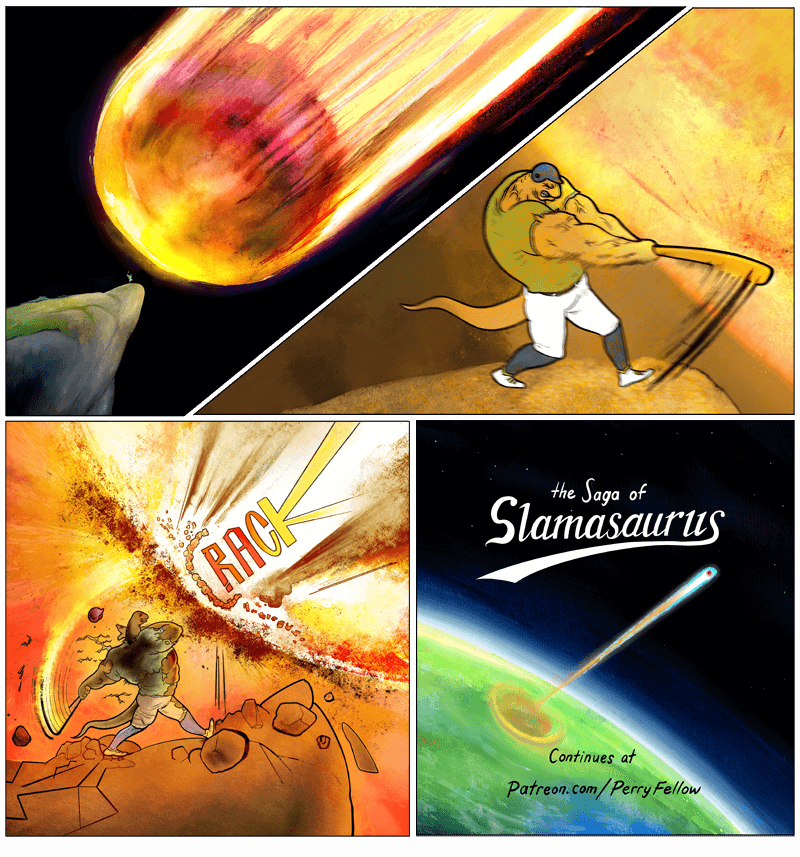
The post Slamasaurus appeared first on The Perry Bible Fellowship.
We are in the midst of another global transformation, but this time we might have the tools to get it right.
To the north side of Bankstown station the rows of shops are under a cloak of rain, with a grey sky above. It has been a few years since I’ve last been over this way, and through the gloom of the rain I look for some of the details I remember: a ghost sign for […]
Self-education can help with personal finance knowledge deficits, which can be more pronounced for women, Economic Education Officer Mary Suiter says in an opinion piece.
Order Keef’s new collection here!

My latest for the Boston Globe.
"If allowed to go ahead, mining will irreversibly destroy ancient deep sea habits and impact those who rely on the ocean for their livelihood."
Pre-orders are live!
Getting the band back together to record some new music.
As always, if you find value in this work I do, please consider helping me keep it sustainable by joining my weekly newsletter, Sparky’s List! You can get it in your inbox or read it on Patreon, the content is the same.
DATE: Sunday 21 August 2022 TIME: 4pm VENUE: 2nd Floor Club Burwood, 97 Burwood Road, Burwood NSW AGENDA: President’s Report; Treasurer’s Report; and Election of Office Bearers. Once again we’ll be offering people an online attendance option conferencing software Big Blue Button, which has a neat built-in poll function for taking votes. An email with the invite code will be sent out to members the day before (Saturday August 20). Any candidate standing for election as an Office Bearer (President, Vice President, Secretary or Treasurer) must be a current DWCA member who has held membership for a minimum period of… Continue reading
The US Supreme Court’s decision to block regulation of carbon emissions at power plants is about more than power plants and more than climate change: it’s part of a long-term […]
“I don’t know how they want to get undressed, above or below the waist, but I think it would be a disgusting sight in any case”, Volodya Pew-teen, as quoted by AP.
I’m just a low-income, sort-of white, ageing, male, semi-educated Aussie worker: a pleb. To rub shoulders with such VIPs is not one of my many privileges, so I have no direct, personal knowledge on those matters and it’s impossible for me to say either way.
Thank goodness!
What I can say with absolute certainty is that this is how people imagined the previous White House tenant:
Ratner and Sim’s “Who Killed the Phillips Curve – A Murder Mystery”
There is broad consensus in both research and policy circles that one of the key reasons for a lack of progress in reducing gender gaps in employment and wages is the persistent gender imbalance in unpaid work, three-quarters of which is performed by women. Universal access to quality care services enables the reduction of this unpaid care work through its redistribution from the domestic sphere to the public sphere, with empirical studies from different regions and countries demonstrating that access to services (in particular, childcare services) substantially increases female labor force participation and labor market attachment.

Publisher: Dragon Moon Press
Written By: J.V. Hilliard
RRP: £12.82 / $19.95 (Paperback) | £3.77 / $4.63 (Kindle)
Reviewed by: Sebastian J. Brook

Pari passu clauses were deliberately crafted to gain an upper hand in sovereign bankruptcy disputes brought to the London stock exchange’s jurisdiction
Few persons, even legal scholars, realize that sovereign bankruptcy has a long history. Far from a pie-in-the-sky scheme conceived in the 1980s by international lawyers such as Christopher Oeschli and economists such as Jeffrey Sachs that later inspired the failed IMF Krueger proposal for a sovereign debt restructuring mechanism, the concept of sovereign debt bankruptcy and discharge (write-off) has an ancient and little known history. My new INET working paper sets out this history for the first time.
Pari passu clauses were deliberately crafted to gain an upper hand in sovereign bankruptcy disputes brought to the London stock exchange’s jurisdiction
Expertise is broken. Trust is eroding. Enough is enough.
While helping at his family’s restaurant, author Ray Boshara has gotten to know the workers and has ideas that speak to their financial aspirations and struggles.
I would like to propose a new term: outrage dividend.
Outrage dividend is the boost in reach that content which elicits strong emotional responses often gets on social media and other content sharing platforms.
This boost can be related to human nature — an outrage-inducing article will get shared more. It can also be caused by the particular set-up of the platform a given piece of content is shared on — Facebook’s post-promoting algorithm was designed to be heavily biased to promote posts that get the “angry” reaction.
A tale of two media outlets
Imagine two media organizations.
A Herald is a reliable media organization, with great fact-checking, in-depth reporting, and so on. Their articles are nuanced, well-argued, and usually stay away from sensationalism and clickbaity titles.