Can I just say how impressed I was with the Democrats during that long Bataan Death March? Not that they had to do much except clap for Hakeem Jeffries over and over again but still, their unity and calm behavior really helped illustrate for the whole country what a circus freak show the right has become. This is how it’s done.
Reading
 With the reality of climate change becoming more apparent in the form of extreme weather events such as heat waves, droughts and floods, it is clear that the future of all life on the planet is in peril. read now...
It's my job, but sometimes I got nothin'.
Trump posted a video of McCarthy thanking the former president on his social media platform Truth Social, captioning it: “Thank you Kevin. It was my great honor.” In the video, McCarthy, who was elected House speaker just past midnight Saturday morning after a historic deadlock, said he doesn’t “think anybody should doubt [Trump’s] influence” and that “he was with me from the beginning.” McCarthy said he talked to Trump Friday night, as the former president and 2024 GOP hopeful helped him secure a victory—four GOP House members that had voted for Rep. Jim Jordan (Ohio) and Andy Biggs (Ariz) in the fourteenth round instead voted “present” in the final round, reducing the threshold needed for a victory. Trump had suffered an embarrassment earlier in the week when many hardline conservatives—formerly Trump’s greatest supporters—ignored his call to support McCarthy after the fourth round of voting on Wednesday to avoid an “embarrassing defeat.” Photos from the chamber also showed Rep.
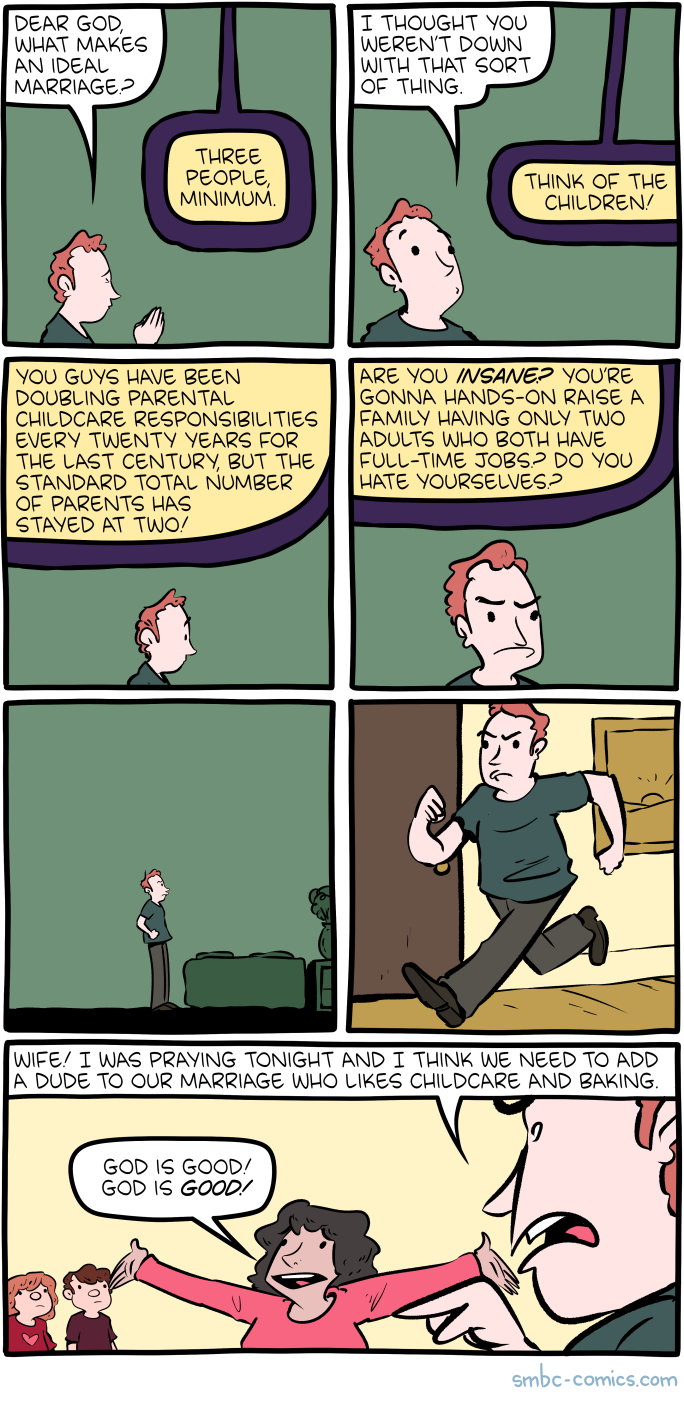
Click here to go see the bonus panel!
Hovertext:
We need to replace gender roles with chores. It's a win for everyone.
Today's News:

“Mr Republican” led the way If you think this Nazi thing is new, even in the upper reaches of the US Government, think again. It’s not. This piece by Mike Lofgren in Salon takes a look at the most famous of all American isolationists, Robert Taft: Readers may be familiar with Rachel Maddow’s explosive new podcast, “Ultra.” It tells the incredible story of a German spy who infiltrated Congress in 1940-41, inducing two dozen congressmen and senators to spread Nazi propaganda in floor speeches, op-ed columns and constituent mailings. Simultaneously, armed extremist groups began training for a violent takeover of the country. In many ways, the eight-decades-old story is a disturbing forerunner of the Trump era. Contrary to our nostalgic memories of unity, America was deeply divided over the war in Europe, military aid to Britain, and whether fascism was the wave of the future that we might as well submit to.
Times puff piece shows Shadow Chancellor pally with George Osborne – apparently she’ll take advice from anyone, as long as they’re not on the left A puff piece in the Murdoch Times – a good indication of just how far to the right Labour has gone under Keir Starmer – shows Shadow Chancellor Rachel Reeves […]
Whatever. The only thing the bill does that actually counts financially is defining gold and silver as currencies rather than commodities, thereby "eliminating the state capital gains tax on gold and silver." Otherwise it confuses "money" as a token used in exchange with a currency as a unit of account functioning as the basis of an accounting system.
SchiffGold
Missouri Bill Would Take Steps Toward Treating Gold and Silver as Money
SchiffGold
Missouri Bill Would Take Steps Toward Treating Gold and Silver as Money
I often don't explain myself, but this song (one of my favorites) is sung by Frank and Scott, and this is Frank singing about Scott's suicide.
- As has been reported, it will only take a single congressperson, acting in what is known as a Jeffersonian Motion, to move to remove the Speaker if he or she goes back on their word or policy agenda.
- A “Church” style committee will be convened to look into the weaponization of the FBI and other government organizations (presumably the CIA, the subject of the original Church Committee) against the American people.
- Term limits will be put up for a vote.
- Bills presented to Congress will be single subject, not omnibus with all the attendant earmarks, and there will be a 72-hour minimum period to read them.
- The Texas Border Plan will be put before Congress.
With changes in the world, the media landscape also changes. There are shifts in particular outlets and new outlets emerge. In this changing landscape, we need a few tools and guide posts for what will be a lively ride in 2023. In 2022 I offered a “feast of new reading” in two parts, here and Continue reading »
What can we expect in 2023 about future human prospects? Will current threats to long-term human survival, continue to increase or will they begin to diminish as a consequence of responses to current threats?” We need governments everywhere to recognise the very serious threats that now face our species. There are now 8 billion humans Continue reading »
Benedict the 16th was not one of my favourite Catholic churchmen. But like his predecessor John Paul II, I always cut them some slack, given their personal encounters with chaos and depravity within their European cultures. A young JPII literally carried acutely weak survivors out of the liberated Auschwitz, in his native Poland in 1944. Continue reading »
It would not be an exaggeration to call Sir Donald Bradman, cricket’s most metronomic and gluttonous of batsman (runs wise), a counter revolutionary. On the surface, cricketers like to imagine themselves to be above politics and devotees of a game so complex it would lobotomise any darting political mind. In practice, cricket has invited the Continue reading »
Stigma is an awful burden for business. But what if – for some companies – stigma is an asset? That’s what I and an international team of researchers set out to investigate in a new paper published in the Journal of Management Studies. We examined how consumers around the world responded to firms in stigmatised industries Continue reading »
The GSCPI peaked at 4.3 standard deviations above its historical mean at the end of 2021, after which it declined substantially. The initial period of decline saw it drop to 2.8 by March 2022, after which it temporarily increased in April, primarily due to pandemic lockdowns in China and the Russia-Ukraine war. The GSCPI then experienced five consecutive months of declines, reaching a low of 0.9 in September. However, the past three months have witnessed a pause in the reversion to the historical average, with the index increasing by a total of 0.29 points in October and November before declining by 0.05 points last month, leaving the total three-month increase at about a quarter point. Synchronously, we have seen a worsening COVID situation in China. The goal of this post is to examine how much of the resurgent upward supply chain pressures can be attributed to China’s evolving policies in response to the current outbreak....Liberty Street Economics — FRBNY
Global Supply Chain Pressure Index: The China Factor
The Jan. 6 committee’s work investigating the Capitol insurrection has been incredibly impressive. Investigators have uncovered new and damning information about Donald Trump’s culpability in the violence of Jan. 6; they’ve reinvented the congressional hearing format to tell a dramatic story and grip the attention of a distractible public; and they’ve shown just how capable Continue reading »
Middle East Eye analyses figures of record Israeli violence in 2022 in which the majority of victims were civilians, including children and journalists. Israeli forces have killed more Palestinians in the occupied West Bank in 2022 than they have in a single calendar year since the Second Intifada, according to data compiled by Middle East Eye. At least 220 people have Continue reading »
We’ve got us a communicator If you weren’t up late last night or were out partying or something you probably missed Hakeem Jeffries’ speech after the vote making Kevin McCarthy speaker.It’s a good one. Let’s hope he’s as good at organizing the Democrats as he is a speaker. If he is, he will be a successful leader.
What has always bothered me about the “experimentalist” school is the false sense of certainty it conveys. The basic idea is that if we have a “really good instrument” we can come up with “convincing” estimates of “causal effects” that are not “too sensitive to assumptions.” Elsewhere I have written an extensive critique of this […]
...they get REALLY wacky. (Thanks to Roberto)
Wells Fargo has terminated its vice president of operations in India after he allegedly urinated on a 72-year-old woman while they both flew business class aboard a recent Air India flight. (Thanks to pharmaross)
Pigeon wearing crystal meth 'like a backpack' caught inside B.C. prison yard (Thanks to Roberto and B&C)
A group of burglars were caught off guard — and on camera — in Alhambra, when they accidentally broke into a diaper cleaning business instead of the medical marijuana dispensary next door. (Thanks to Ralph)